Weakest Link
As the saying goes, a chain is only as strong as its weakest link.
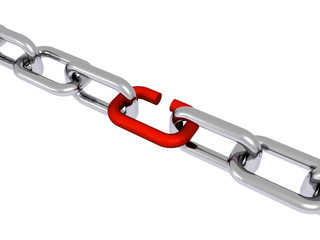
It is also true that a family is only as strong as its weakest dyad. A dyad is a relationship between two people. So a family of four has six dyads. Mom to and from Dad (1), Dad to and from each kid (2), Mom to and from each kid (2) and of course older kid to and from younger kid (2). So you can see the more members of the family the larger the number of dyads.
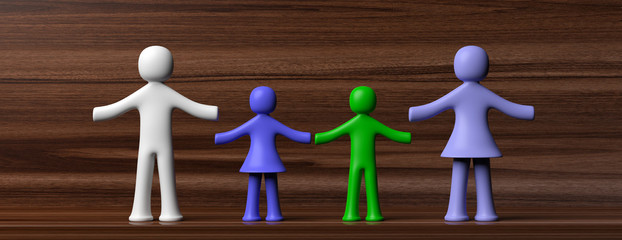
When all of the dyads are healthy, the family is highly likely to be healthy overall. When even one link is not healthy it can serve to weaken the whole family. Think about it, can you recall a family where two siblings did not get along and it colored the dynamics in the rest of the family? Some members of the family changing their behavior to appease one or both of the two that are not getting along. Or families that look like the one in the picture about and each parent has a favorite child?
Family counseling can help identify the weak dyads, the possible reasons the dyads are weak, and assist the entire family in making the family system (the chain) strong again. Keeping balance in the family is not easy. We can work with you to help strengthen the dyads that will make your family strong.
Rosemary Behrens, Ph.D. Family Counselor
Crazy Love: The Signs of Domestic Abuse
Sometimes stress on the family can change from discord to abuse.
Domestic abuse comes in many varieties and is not restricted to socioeconomic level, age or culture. Nor is it restricted to physical abuse. Before we can assist victims of domestic abuse we must first gain an understanding of the ways that abuse happens, many of which do not leave visible scars. When we can gain a better understanding of the different types of abuse, the cyclical nature of abuse and productive ways to assist the abused, we can better identify when loved ones are in the midst of abusive situations and help them emerge on the other side. What the abuse victim needs most is love and care and an outlet to share their struggles. What they do not need is a savior to swoop in and save the day. Abuse comes in many forms besides physical abuse. Verbal abuse, emotional abuse, social abuse, cultural abuse, sexual abuse, using the kids for abuse are but a few of the ways that abuse can happen without leaving visible scars to prove the abuse.
Survivors of Childhood Sexual Abuse Workshop
Workshop Date: May 19, 10:00 AM – 12:00 PM Location: 9219 Katy FWY., Suite 165 Houston, TX. 77024
“Sexual abuse can be hard to define because of the many different forms it can take on, the different levels of frequency, the variation of circumstances it can occur within, and the different relationships that it may be associated with.” Hall and Hall
There are varied reactions to childhood sexual abuse. These reactions are highly dependent on the age the abuse started, the frequency of abuse, the time of the outcry, the reaction of the nonoffending parent, and the nature of the relationship with the abuser. Inner Peace Counselors is presenting a workshop for Survivors of Childhood Sexual Abuse in May.
The topics to be covered are as follows:
- Transforming anger into a sense of release
- Rebuilding self-esteem
- Understanding how other parts of life have been affected and
- Moving from surviving to thriving
Anger: Anger is a common (and appropriate) reaction of survivors of childhood sexual abuse. Anger often impacts the one who is angry more than the target of that anger. Anger can also be internalized and increase stress, anxiety and depression. Letting go of the anger is not synonymous with forgiving the abuser. Learning how to release the anger and move in a more positive direction is a step toward healing. It is also a step toward releasing the power that the abuser continues to hold on the survivor.
Low self Esteem: Another common concern for survivors of childhood sexual abuse is low self-esteem. This is a common phenomenon because verbal and emotional abuse usually accompany childhood sexual abuse. Low self-esteem can leave survivors vulnerable to future forms of abuse and can lead to unhealthy adult relationships. Rebuilding self-esteem can be accomplished by focusing more on positive accomplishments that have happened and focusing less on the negative voices that berate us. Sometimes it is necessary to change the people around you. Much like an airplane, self-esteem builds much faster for survivors who surround themselves with people who lift their spirits rather than people who drag their spirits.
Low Trust: It is important to gain an understanding of how childhood sexual can have long lasting impacts on many aspects of our lives. Being abused by someone in your family who you are supposed to be able to trust will invariably lead to trust issues for the adult who has survived childhood sexual abuse. Being exposed to sexual activity before a child has reached an appropriate level of social development for sexual development to begin can distort adult sexual behavior. It is common for survivors to either be afraid of having sex with anyone or feel that they must have sex with everyone. It is also common for survivors to dissociate during sexual activity.
Anxiety: Survivors of childhood sexual abuse are likely to experienced heightened anxiety. Anxiety is our body’s way of responding to perceived threats. This response is noted as the fight or flight response. Another response option is to freeze. Heightened anxiety lays the groundwork to perceive threats in situations that are non-threatening. It can also lead to paranoia and even panic attacks. Survivors sometimes respond to the loss of control experienced in the abuse by exerting control over an area of their life that they have control, their weight. This control may take the form of anorexia or bulimia or significant weight gain in the hopes of becoming unattractive to the abuser.
Thriving: Moving from surviving to thriving is accomplished when the survivor recognizes the ways that that their anger, self-esteem and other areas of their life have been distorted by the abuse they have survived. Thriving does not mean that the abuse is forgotten or forgiven, it means that it has lost its power.
Quotes:
The knot in the bark reminds the tree of trauma survived. The knot may soften but it remains to remind the tree that it has indeed survived. –Rosemary Behrens
Childhood sexual abuse leaves scars that may fade but never completely go away, however, you can reduce, dissipate or transform the pain into release and wisdom. — Rosemary Behrens.
“I tell you, Chickadee
I am afraid of people
who cannot cry
Tears left unshed
turn to poison
in the ducts.” Alice Walker
Rosemary D. Behrens, PhD, LPC-S
9219 Katy FWY.
Suite 165
Houston, TX. 77024
Office: 832-470-7890